CertForge is the governance layer above your certificate infrastructure — policy enforcement, human approvals, and full audit trails for every TLS certificate, whether issued by cert-manager, ACME clients, or your internal CA.
Start Free — No card requiredInstall the cert-manager external issuer, point an ACME client at CertForge, or call the REST API directly from any system.
Set domain rules, trusted CAs, TTL limits, and multi-level approval workflows across all certificate sources.
Certificates issue automatically after policy and approval. Every action is audited and sent to your SIEM.
Define which domains, CAs, and validity periods are allowed. Requests that violate policy are rejected before a certificate is ever issued.
High-value or out-of-policy requests route to an approval queue. Approvers are notified via Slack, Teams, or Webex.
Every approval decision is chained with a cryptographic hash — any deletion or modification breaks the chain instantly. Learn how it works →
Certificate events stream in real time to Splunk, Datadog, Sentinel, and more — including the originating namespace and workload name.
cert-manager is exceptional at automating certificate lifecycle in Kubernetes. What it was never designed to do is enforce who can request what, require approvals for sensitive domains, or produce an audit trail that satisfies a compliance team.
Install the CertForge external issuer, point your CertForgeIssuer at your API token, and every Certificate resource in your cluster now flows through CertForge's policy engine — without changing a single workload manifest.
Most organizations have shadow certificates — issued directly to Let's Encrypt or a cloud CA, bypassing your governance process entirely. With 47-day lifetimes, a forgotten cert is an outage waiting to happen.
CertForge scans Certificate Transparency logs daily for every domain you register. Self-hosted deployments also scan the local filesystem automatically. Every discovered cert is cross-referenced against what CertForge manages — unmanaged certs surface immediately as findings.
Learn about Discovery →Daily scans of Certificate Transparency logs via crt.sh for every domain you register.
Self-hosted deployments scan standard cert paths automatically — no extra agents needed.
Known-managed certs are automatically flagged. Only unmanaged certs surface as findings.
Discovered certs show days remaining. Certs expiring within 30 days are highlighted immediately.
Every pending request gets an instant risk score — wildcard scope, CA trust, domain sensitivity, and request velocity all factored in.
Instead of raw event data, approvers see a one-line summary of what's anomalous and why it matters.
Approvers spend seconds, not minutes. Context is surfaced at the point of decision — no digging through logs.
Unusual patterns — off-hours requests, new domains, atypical issuers — are flagged before an approver ever opens the queue.
A compliance approver reviewing a certificate request shouldn't need to cross-reference logs, check domain history, and assess CA trust manually. CertForge does that work automatically.
Every request in the approval queue arrives with an AI-generated risk score and a plain-English explanation of any anomalies — so decisions are fast, documented, and defensible in a SOC 2 or ISO 27001 audit.
Learn about AI Governance →Teams managing hundreds of production domains with full governance and visibility.
Already running cert-manager? Add governance, policy, and audit trails in minutes with the CertForge external issuer — no changes to existing workloads required.
SOC 2, ISO 27001, PCI-DSS, and HIPAA-ready teams that need strong audit trails and approvals.
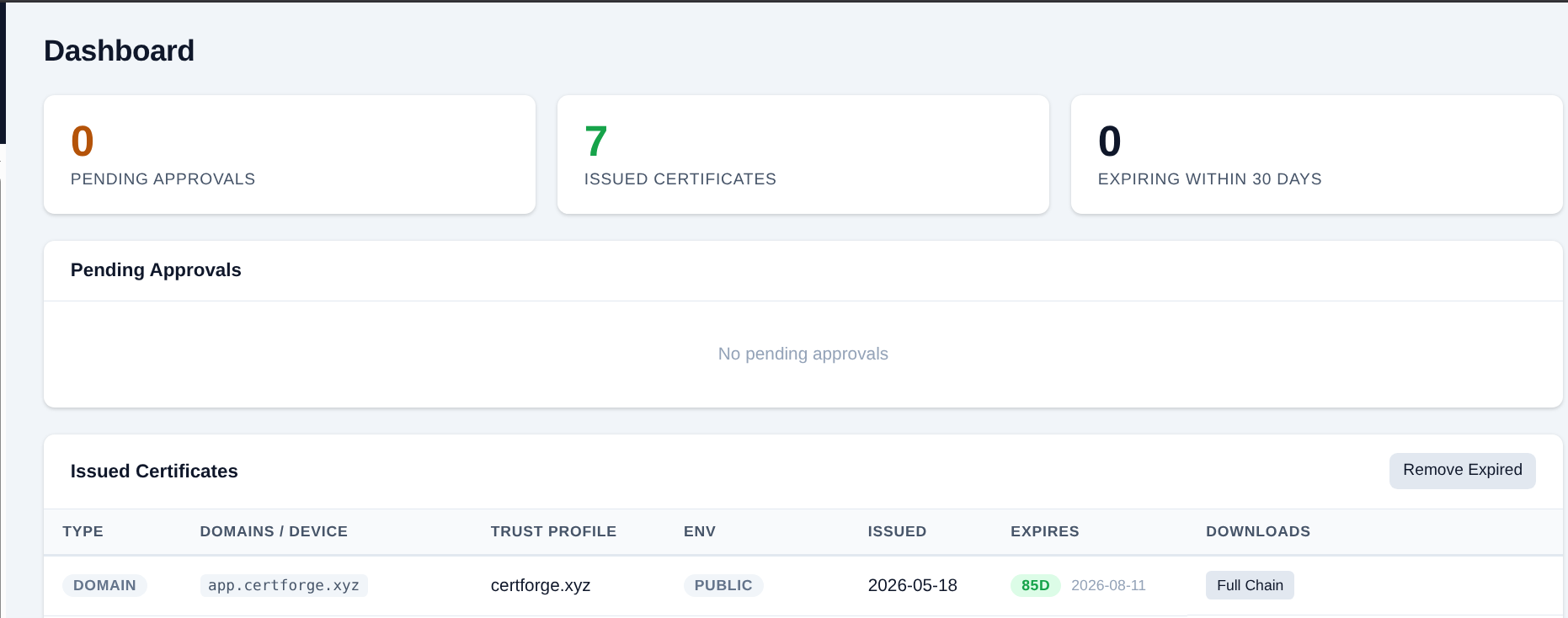
Real-time visibility into certificates, approvals, and expiring items.
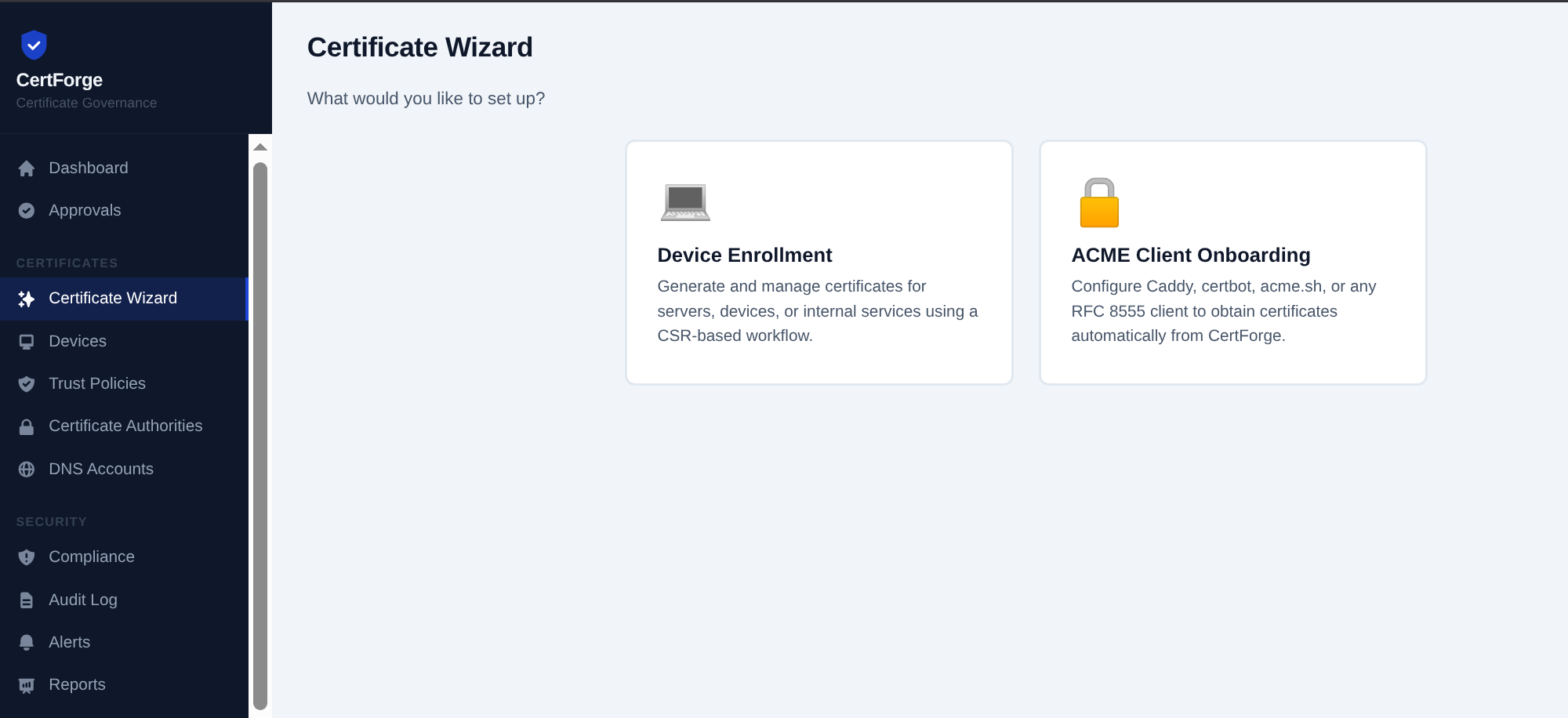
Easy onboarding for devices and ACME clients.
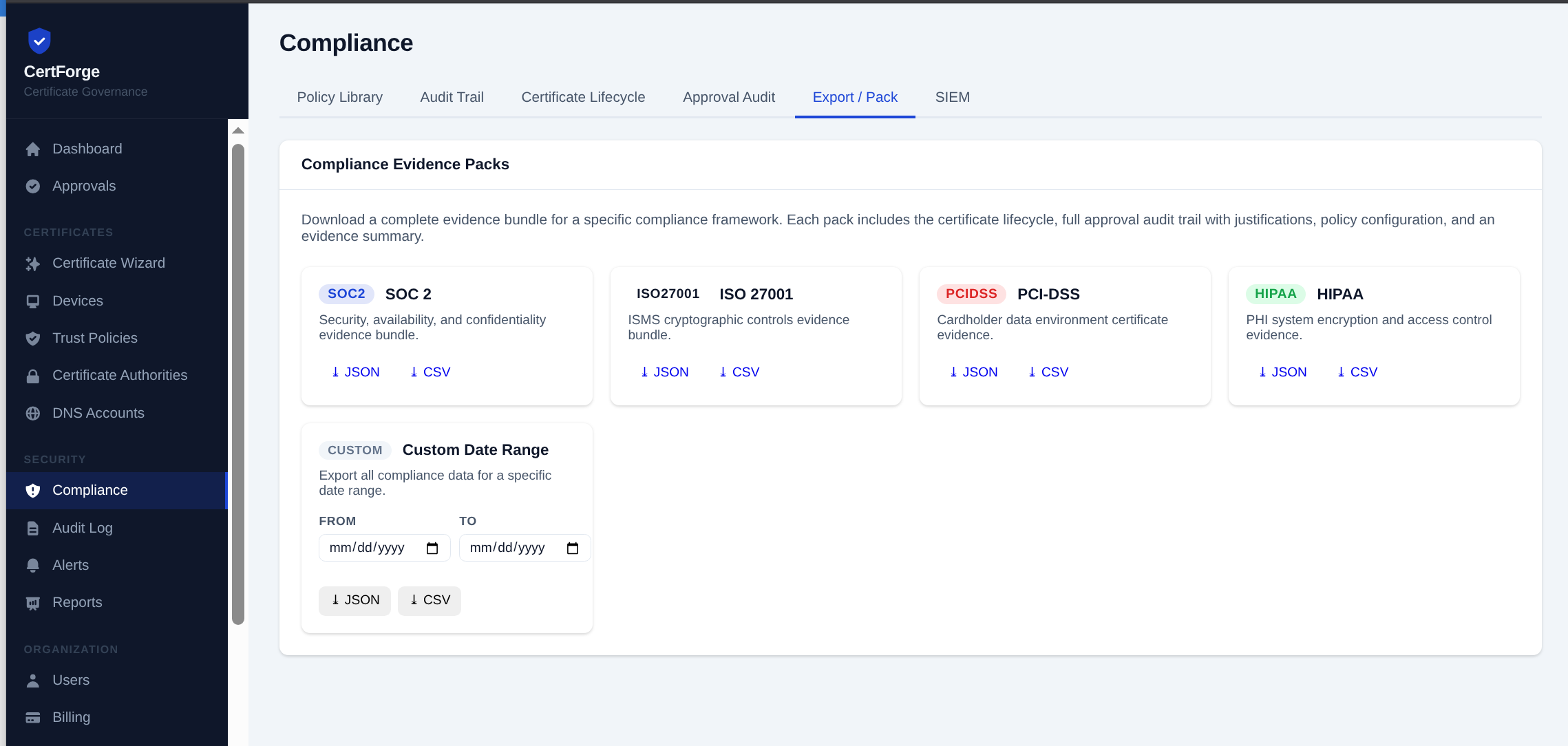
Built-in support for SOC 2, ISO 27001, PCI-DSS, and HIPAA-ready controls.
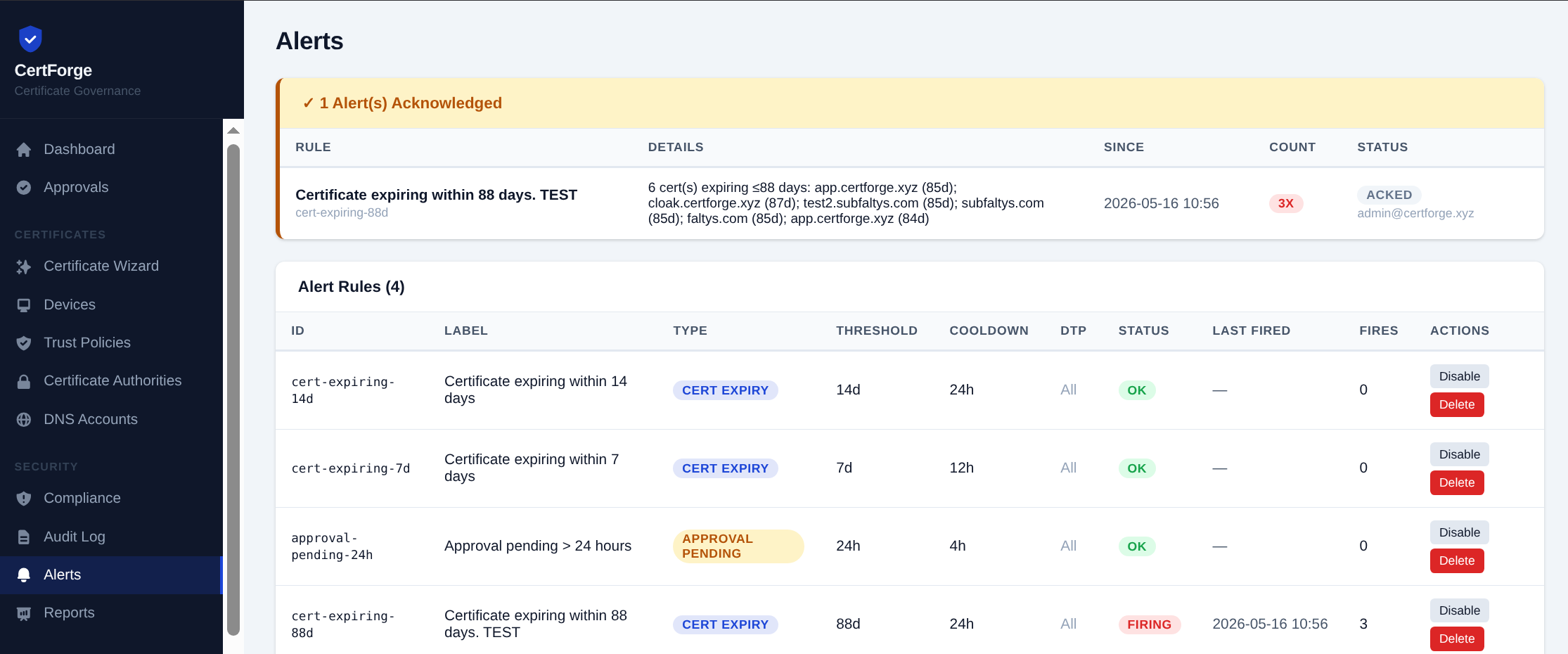
Proactive notifications before certificates expire or policies are violated.